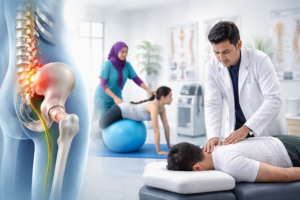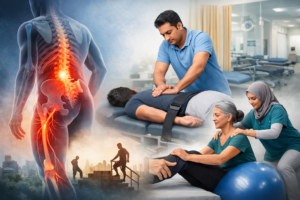

Sciatica is one of the most disabling nerve-related pain conditions affecting adults across Bangladesh today. Unlike simple back pain, sciatica involves irritation or compression of the sciatic nerve, the longest nerve in the human body. This condition typically causes pain that starts in the lower back and radiates through the buttock, thigh, and sometimes down to the leg and foot. In many cases, patients also experience numbness, tingling, muscle weakness, or difficulty walking and sitting for long periods. Because the pain follows the pathway of the nerve, it can significantly interfere with everyday activities such as working, driving, resting, or even sleeping.
In Bangladesh, the number of people suffering from sciatica has been steadily increasing. Sedentary office jobs, long hours of sitting, poor posture, heavy manual labor, and limited awareness of spinal health have contributed to this growing problem. Many individuals initially depend on painkillers, injections, or prolonged rest to control their symptoms. While these methods may temporarily reduce discomfort, they often fail to address the underlying cause of nerve compression. As a result, the pain frequently returns and may gradually become chronic. In some situations, patients are advised surgery without receiving structured physiotherapy or conservative treatment first.
Modern medical research shows that the majority of sciatica cases can be effectively treated through specialized non-surgical care when accurate diagnosis and proper rehabilitation are provided. The expertise of the treating doctor plays a crucial role in this process. Understanding spinal biomechanics, nerve physiology, and movement dysfunction is essential to identifying the root cause of sciatica and developing an effective treatment strategy.
In Bangladesh, Dr. Mohammad Shahadat Hossain, PT and Dr. Sapia Akter, PT have gained recognition for their expertise in non-surgical spine and nerve pain management. Their work at ASPC Manipulation Therapy Centre focuses on treating the root cause of sciatica rather than simply suppressing pain symptoms. This approach has helped many patients recover safely and return to their normal daily activities without unnecessary surgery.
Dr. Mohammad Shahadat Hossain, PT
Widely respected for clinical expertise in spinal biomechanics and manipulation therapy. His approach begins with a detailed assessment of posture, mobility, and nerve function to identify the exact source of compression, applying advanced manual therapy to restore alignment and relieve pressure.
Dr. Sapia Akter, PT
Leading the rehabilitation process, Dr. Akter designs structured programs for posture correction, core strengthening, and movement re-education. Her patient-centered approach ensures rehabilitation progresses safely while reducing recurrence risk.
Understanding Sciatica: More Than Just Leg Pain
Sciatica is not a disease itself; it is a group of symptoms caused by irritation or compression of the sciatic nerve or its nerve roots in the lumbar spine. The sciatic nerve is the longest and thickest nerve in the human body, running from the lower back through the hips, buttocks, and down each leg.
Key Symptoms
- Radiating pain from lower back to leg
- Burning or electric shock-like sensations
- Tingling or numbness in foot or toes
- Muscle weakness & walking difficulty
Clinical Complexity
From a clinical standpoint, sciatica is challenging because pain severity does not always correlate with MRI findings. This complexity requires a specialist who understands both structure and nerve physiology beyond imaging alone.
Common Causes of Sciatica in Bangladesh
- Structural: Lumbar disc herniation, Degenerative disc disease, Spinal stenosis.
- Mechanical: Weak core and hip muscles, Piriformis muscle tightness.
- Lifestyle: Prolonged sitting, Repetitive bending, Heavy lifting.
- Injury: Previous spinal trauma or occupational strain.
Why Choosing the Right Sciatica Doctor Matters
Sciatica is often mismanaged because treatment focuses only on pain suppression. Painkillers, injections, or prolonged rest may reduce symptoms temporarily but fail to address nerve mechanics, spinal loading, and movement dysfunction.
The best sciatica doctor in Bangladesh must understand spine biomechanics, nerve sensitivity behavior, and stage-wise treatment progression. Incorrect or aggressive treatment can worsen nerve irritation and delay recovery.
ASPC Manipulation Therapy Centre: A Trusted Destination
ASPC Manipulation Therapy Centre is widely recognized for its ethical, patient-centered, and result-oriented approach to spine and nerve pain. Rather than using routine protocols, ASPC emphasizes root-cause diagnosis and personalized treatment planning.
SDM (Spinal Decompression Method): A Core Treatment
One of the most effective non-surgical treatments used at ASPC is SDM. This specialized technique is designed to reduce pressure on spinal discs and nerve roots without surgery.
Comprehensive Sciatica Assessment and Treatment
Every patient undergoes a detailed assessment including pain history, neurological screening, mobility testing, and postural/gait analysis. Following this, a step-by-step approach is implemented:
- Initial nerve calming and pain management
- SDM (Spinal Decompression Method)
- Manual therapy for spine and pelvis
- Nerve mobilization techniques
- Core stabilization training
- Hip and lower limb rehabilitation
- Postural and ergonomic correction
- Functional movement re-education
- Customized home exercise program
- Ongoing monitoring and progression
Patient Feedback and Satisfaction
- Clear explanation of condition and root cause (patients finally understand ‘why’ it hurts)
- Treatment is gentle, respectful, and confidence-building
- Honest discussion of options without pressure for surgery
- Gradual but long-lasting pain improvement and reduced medication dependence
- Active involvement in the recovery process with regular progress monitoring
Comparison: Institutional vs. Specialized Spine Care
Across Bangladesh, patients often seek help from general physicians or large institutions like CRP (Centre for the Rehabilitation of the Paralysed), NITOR (Pongu Hospital), and BHPI. These facilities play an essential role in the medical system but often treat a broad range of trauma and orthopedic issues. Due to high patient volumes, individualized nerve-focused treatment can sometimes be limited.
In comparison, the approach at ASPC by Dr. Mohammad Shahadat Hossain and Dr. Sapia Akter focuses specifically on spinal alignment and nerve function. While many private clinics in Dhaka or Chattogram rely heavily on machines (electrotherapy, ultrasound), ASPC prioritizes advanced manual therapy, clinical reasoning, and integrated diagnosis to achieve sustainable recovery rather than temporary relief.
Regain Your Mobility and Confidence
Sciatica is complex, but with expert non-surgical care, most patients achieve long-term recovery without surgery. Through the combined expertise in diagnosis, manual therapy, and rehabilitation, Dr. Mohammad Shahadat Hossain and Dr. Sapia Akter provide a clear, scientific pathway to a healthier, more active life.
ASPC Manipulation Therapy Centre — Specialized Non-Surgical Spine Care