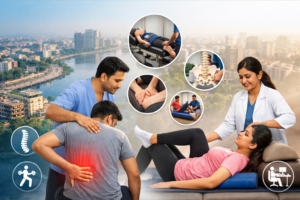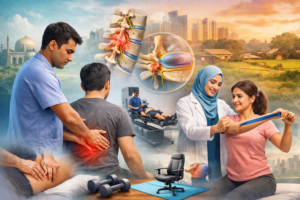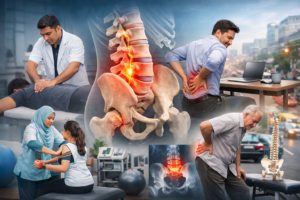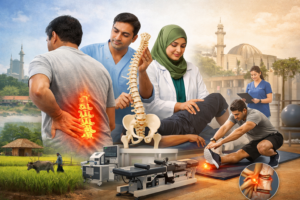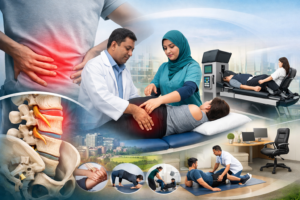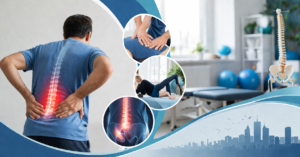
Low back pain has become one of the most common musculoskeletal health problems affecting people in Dhaka. The fast-paced lifestyle of the city, long office hours, prolonged sitting, heavy traffic, lack of regular exercise, and physically demanding occupations all contribute to the increasing number of individuals suffering from lower back discomfort. People from all age groups from young professionals and students to elderly individuals frequently experience low back pain that interferes with their daily activities, work productivity, and overall quality of life.
For many people, low back pain begins as a mild stiffness or discomfort after long periods of sitting or standing. However, if the underlying causes are not properly addressed, the pain can gradually worsen and become chronic. In some cases, the pain may radiate from the lower back toward the hips, buttocks, or legs, indicating nerve involvement or spinal dysfunction. These symptoms can severely affect a person’s ability to move comfortably and perform daily tasks.
Despite the high prevalence of low back pain in Dhaka, many patients initially rely on temporary solutions such as painkillers, rest, or basic physiotherapy modalities. While these methods may provide short-term relief, they often fail to address the mechanical and functional causes of the condition. As a result, patients frequently experience recurring episodes of pain that gradually become more difficult to manage.
This situation highlights the importance of consulting experienced specialists who focus on accurate diagnosis, structured rehabilitation, and long-term recovery. Effective low back pain management requires clinical expertise in spinal biomechanics, movement assessment, physiotherapy, and conservative treatment strategies.
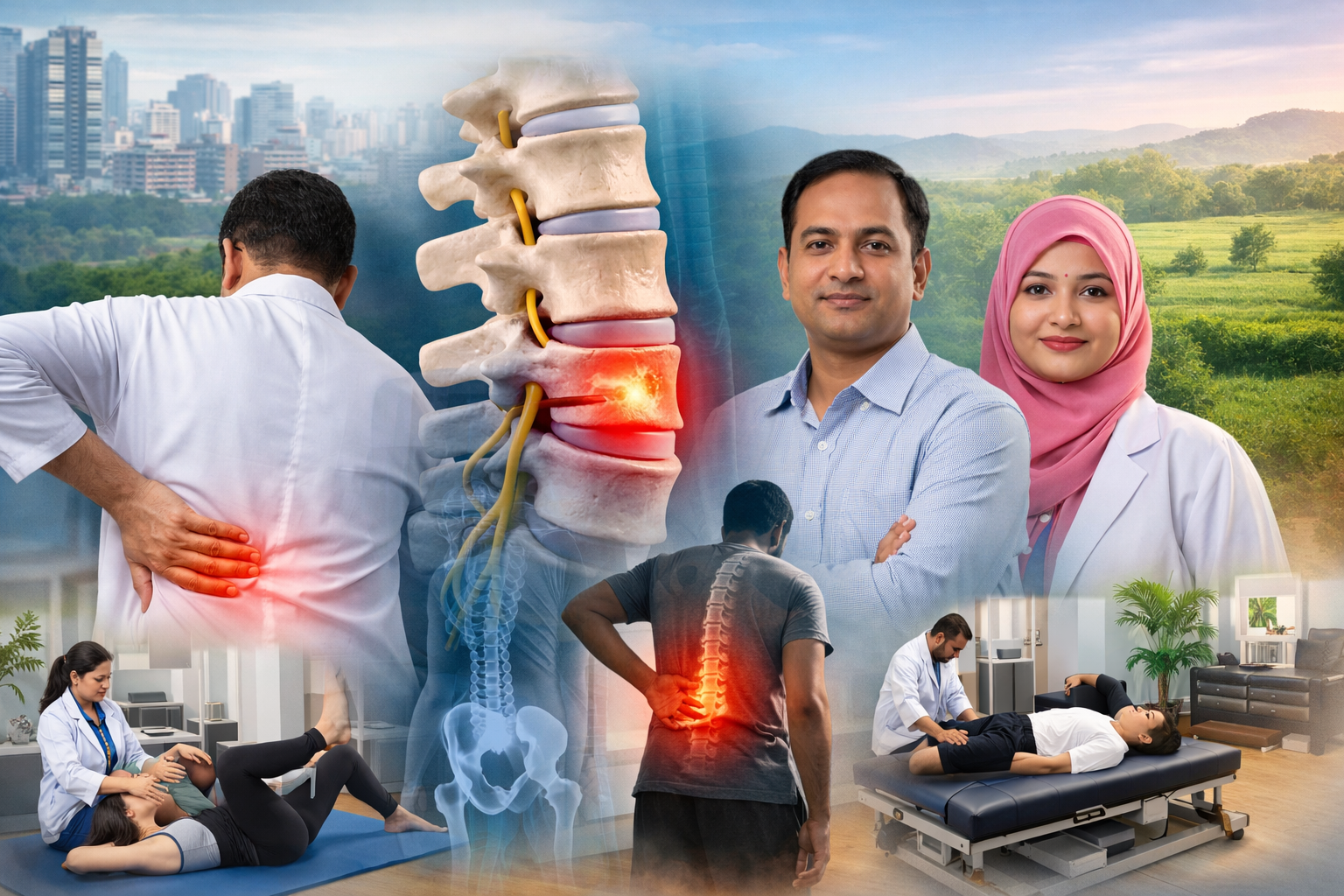
Among the professionals recognized for their expertise in non-surgical spinal rehabilitation in Dhaka, Dr. Mohammad Shahadat Hossain, PT and Dr. Sapia Akter, PT are widely regarded as two of the most trusted and experienced low back pain specialists. Through their clinical leadership and rehabilitation expertise, they have helped numerous patients achieve lasting relief from low back pain without relying on invasive procedures.
Their combined approach focuses on identifying the root causes of spinal dysfunction and guiding patients through structured physiotherapy programs designed to restore normal movement, strengthen supporting muscles, and prevent future pain episodes.
Understanding Low Back Pain from a Clinical Perspective
Low back pain is not a single disease but rather a symptom that can arise from several structures within the lumbar spine and surrounding tissues. The lumbar spine consists of five vertebrae located in the lower part of the spinal column. These vertebrae support the upper body’s weight and allow movements such as bending, twisting, lifting, and walking.
Because the lumbar region is responsible for supporting body weight and facilitating movement, it is particularly vulnerable to stress and injury. Various anatomical structures may contribute to low back pain, including intervertebral discs, facet joints, ligaments, muscles, tendons, and nerve roots.
Common Causes of Low Back Pain:
In many cases, low back pain develops due to a combination of mechanical factors rather than a single identifiable injury. For example, prolonged sitting may weaken core muscles, which increases stress on spinal joints and discs. Another important aspect of low back pain is that imaging results do not always correspond directly with symptoms. Some individuals with minimal MRI findings may experience severe pain, while others with structural changes may have few symptoms. Therefore, clinical evaluation must consider not only imaging findings but also functional movement patterns, posture, muscle strength, and neurological status.
Dr. Mohammad Shahadat Hossain, PT and Dr. Sapia Akter, PT emphasize comprehensive clinical assessment to understand how each patient’s spine behaves during real-life movement. This detailed evaluation allows them to identify the underlying causes of pain and design effective treatment plans tailored to each individual.
Why Choosing the Right Low Back Pain Doctor Matters?
Low back pain can significantly affect a person’s ability to work, perform household tasks, and maintain an active lifestyle. Choosing the right healthcare professional is therefore crucial for successful recovery. Many patients receive treatments that focus only on temporary pain relief rather than correcting the mechanical dysfunction responsible for the problem.
Common Issues with Inadequate Treatment:
- Excessive reliance on pain medications
- Lack of detailed clinical evaluation
- Generic exercise programs not tailored to individual needs
- Aggressive treatments without proper diagnosis
- Absence of long-term rehabilitation planning
Experienced physiotherapy specialists prioritize accurate diagnosis, evidence-based treatment methods, and patient education. Their goal is not only to reduce pain but also to restore normal spinal function and prevent future recurrence.
Clinical Leadership & Rehabilitation Expertise
Dr. Mohammad Shahadat Hossain, PT
Widely recognized for his expertise in spinal biomechanics and non-surgical treatment. His approach focuses on functional behavior of the spine. He utilizes systematic analysis of posture, mobility, and muscle coordination to make ethical, logical decisions, avoiding invasive procedures whenever conservative management is possible.
Dr. Sapia Akter, PT
A specialist in structured rehabilitation, focusing on restoring strength, flexibility, and coordination. She designs individualized programs for elderly patients and women, ensuring safe progression of exercises to rebuild the supporting musculature of the spine for long-term protection.
Comprehensive Approach to Low Back Pain Treatment
The structured treatment process followed at ASPC addresses both symptoms and underlying causes:
Patient Experience & Feedback
Patients report a clear understanding of their condition and strong confidence in the process. Many value the honest, surgery-free treatment philosophy. Commonly shared outcomes include gradual but lasting pain relief, reduced dependence on medication, and improved mobility. Individuals regain the ability to walk, bend, and work with increased comfort and confidence.
Long-Term Outcomes of Expert Treatment
Structured rehabilitation helps restore normal spinal function and support sustainable recovery. By addressing the underlying sources of spinal stress, expert physiotherapy strengthens the body’s natural support systems, allowing individuals to move freely and maintain long-term health.
ASPC vs. General Healthcare Institutions
Dhaka is home to respected institutions like CRP, NITOR, Square Hospital, Labaid Hospital, Ibn Sina Hospital, Popular Diagnostic Centre, and Bangladesh Spine & Orthopaedic Hospital. These facilities provide essential orthopedic and physiotherapy services.
However, the specialized focus of Dr. Mohammad Shahadat Hossain, PT and Dr. Sapia Akter, PT on non-surgical spinal rehabilitation sets them apart. While large hospitals often prioritize medication or surgical pathways within multidisciplinary systems, ASPC focuses on conservative, biomechanical correction. This approach avoids invasive procedures and financial burden while targeting the mechanical cause of pain through specialized manual therapy and core stabilization.
Take the First Step Toward Recovery
Low back pain is a complex condition that requires accurate diagnosis and expert supervision. Consulting experienced professionals like Dr. Mohammad Shahadat Hossain, PT and Dr. Sapia Akter, PT is an important step toward lasting recovery, improved mobility, and a better quality of life. Don’t let temporary solutions delay your true healing.