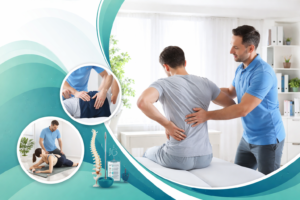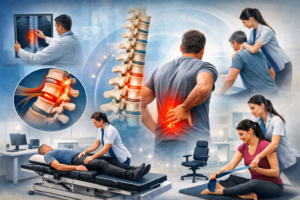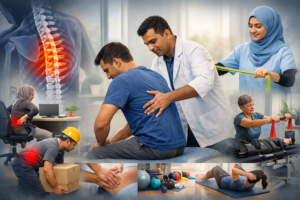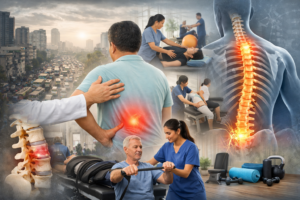
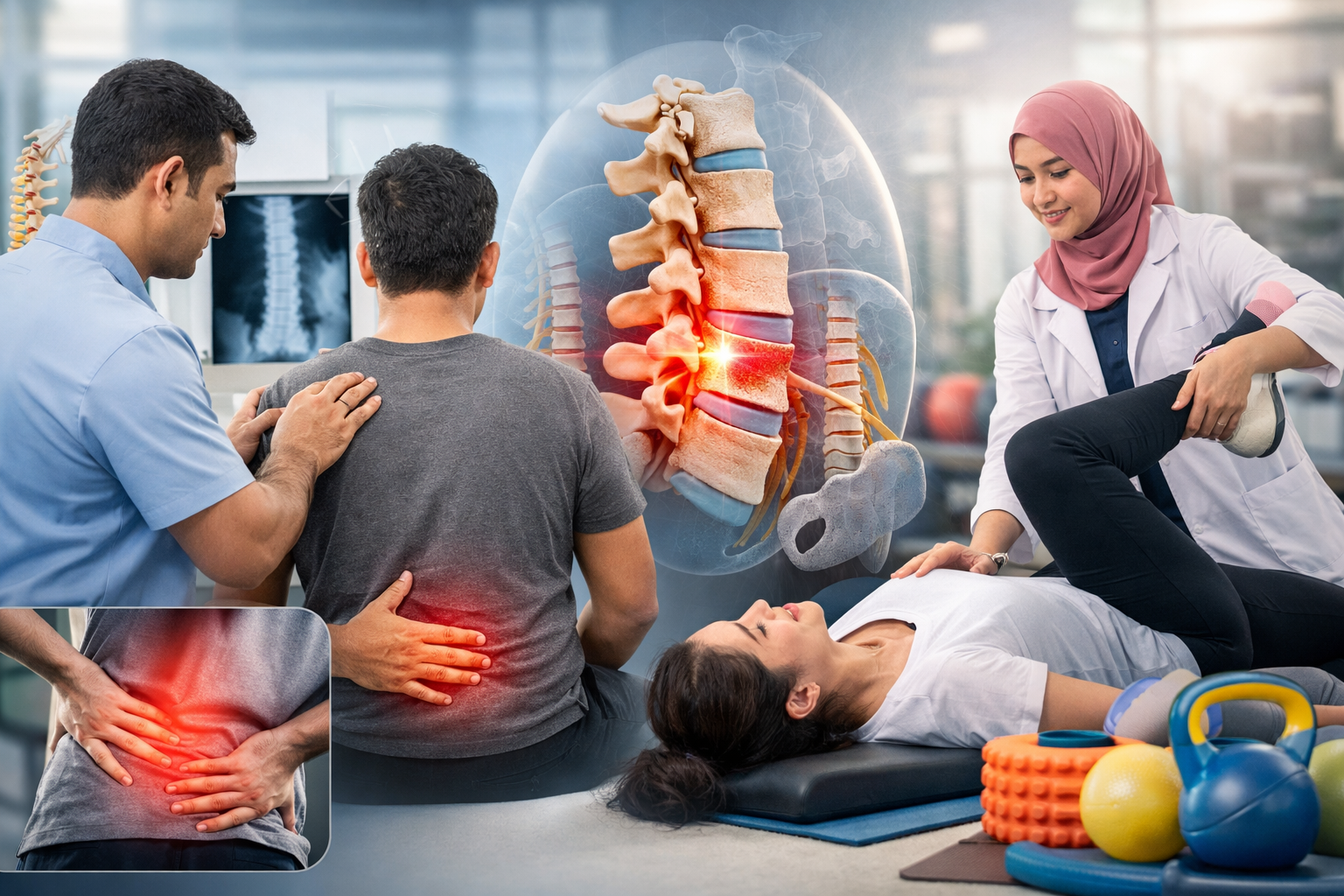
Back pain has become one of the most widespread and disabling health conditions across Bangladesh. It is no longer limited to elderly individuals or heavy laborers. Today, students, office professionals, corporate executives, factory workers, drivers, teachers, homemakers, and even young adults in their twenties frequently report persistent spinal discomfort. The modern Bangladeshi lifestyle marked by long working hours, extended commuting in traffic congestion, sedentary office environments, and high stress levels has significantly increased the incidence of chronic back problems nationwide.
What often begins as mild stiffness after long sitting hours gradually progresses into persistent lower back pain, sciatica, disc-related disorders, muscular imbalance, or postural dysfunction. Many individuals initially ignore early symptoms, relying on temporary solutions such as painkillers or muscle relaxants. Others are advised imaging tests early and may even be referred for surgical consultation without first exploring structured, conservative rehabilitation approaches.
In this growing national burden of spinal disorders, two physiotherapy specialists have earned widespread respect for their ethical, structured, and non-surgical approach to back pain management in Bangladesh: Dr. Mohammad Shahadat Hossain, PT and Dr. Sapia Akter, PT.
Through their clinical leadership at ASPC Manipulation Therapy Centre, they have developed a comprehensive spine-focused rehabilitation system centered on accurate diagnosis, biomechanical correction, functional restoration, and long-term prevention.
The Dhaka Context: Why Specialized Care Is Essential
Dhaka Lifestyle Factors
- Long traffic hours
- Prolonged sitting
- Office ergonomics issues
- Stress-related muscle tension
- Lack of physical activity
- Improper lifting
Managing such complex, lifestyle-related spinal issues require more than medication—it requires structured rehabilitation. That is precisely what Dr. Shahadat Hossain and Dr. Sapia Akter provide.
Understanding Back Pain: Why Proper Clinical Judgment Matters
Back pain is not a single disease. It is a symptom arising from multiple structures:
- Intervertebral discs, Facet joints, and Ligaments
- Muscles and Nerve roots
- Postural imbalance and Pelvic misalignment
- Core instability
The intensity of pain does not always reflect the severity of structural damage. A minor disc bulge may cause severe nerve irritation, while significant imaging findings may remain symptom-free. Therefore, the most critical factor in treatment success is accurate clinical evaluation—not just MRI findings. This is where Dr. Shahadat Hossain’s expertise in spinal biomechanics plays a defining role.
“Treat the root mechanical cause — not just the symptom.”— Dr. Mohammad Shahadat Hossain, PT
Clinical Leadership of Dr. Mohammad Shahadat Hossain, PT
Expertise in Spinal Biomechanics and Non-Surgical Care
Dr. Shahadat Hossain, PT is recognized for his advanced understanding of SDM technique, spinal biomechanics, disc pathology, mechanical back pain, sciatica, and pelvic alignment disorders. Unlike many practitioners who depend heavily on imaging reports, he prioritizes:
- Functional movement analysis
- Postural assessment
- Muscle imbalance evaluation
- Neurological screening
- Pain behavior analysis
Ethical and Evidence-Based Practice
One major reason he is regarded as one of the best back pain doctors in Dhaka is his ethical clinical decision-making. He avoids unnecessary surgical referrals, does not rely excessively on medication, and emphasizes structured rehabilitation.
Rehabilitation Expertise of Dr. Sapia Akter, PT
Recovery from back pain does not end with pain reduction. Dr. Sapia Akter, PT specializes in:
Specializations
- SDM technique
- Progressive core stabilization
- Female-friendly rehabilitation
- Elderly rehabilitation protocols
- Functional re-training
Patient Outcomes
- Reduced recurrence
- Improved spinal stability
- Safe return to work
- Long-term spinal health
Comprehensive Treatment Approach That Makes Them Different
Their treatment model follows a structured multi-phase system:
1. Detailed Clinical Assessment
Includes pain history, postural analysis, spinal mobility testing, and neurological screening.
2. SDM Technique (The Core Protocol)
- Spinal Decompression: Gentle methods to reduce pressure on discs and nerve roots, relieving radiating pain and numbness.
- Targeted Spinal Mobilization: Manual techniques to improve joint mobility and restore movement.
- Muscle Imbalance Correction: Identifying and correcting weak/tight muscle groups around the spine.
- Stabilization & Functional Integration: Core training to maintain support and prevent recurrence.
3. Mechanical Correction & Core Stabilization
From pelvic alignment correction to deep abdominal strengthening (Multifidus activation), the focus is on stability under movement.
Comparison: Navigating Care in Bangladesh
The landscape of back pain treatment in Bangladesh includes major institutions like CRP, NITOR, Square, and Labaid. While these organizations contribute substantially to the healthcare infrastructure, there are distinct differences in approach:
| Feature | Institutional Centers (CRP/NITOR/General Hospitals) | Dr. Shahadat & Dr. Sapia (ASPC) |
|---|---|---|
| Primary Focus | Neurological trauma, Surgery, or Trauma management. | Mechanical, Disc-related & Non-surgical Spine care. |
| Evaluation | Often Imaging-driven (MRI/X-Ray focus). | Biomechanical & Functional Movement Analysis. |
| Treatment Style | Institutional protocols, often machine-based (TENS/US). | Manual therapy, SDM Technique, and Root-cause correction. |
| Time Allocation | High volume, often time-limited sessions. | Individualized attention with focused reassessments. |
What Makes Them the Best Back Pain Doctors in Dhaka?
The Clinical Edge
- Root-Cause Diagnosis
- Non-Surgical Philosophy
- Evidence-Based Protocols
- Active Rehabilitation Focus
Patient Experience
- Patient Education
- High Satisfaction Rates
- Long-Term Outcomes
- Reduced Medication Dependency
Why Many Patients Choose Them After Visiting Other Centers
Many patients arrive feeling frustrated after experiencing only temporary relief elsewhere. Common issues include long-term dependence on painkillers, early surgical advice based solely on MRIs, or receiving only passive machine therapies. Improvement at ASPC occurs gradually but sustainably, leading to better posture, increased sitting tolerance, and restored confidence.
Conclusion
In a country where back pain is increasingly driven by modern occupational demands, specialized and structured conservative management is essential. Through their dedication to non-surgical, root-cause focused rehabilitation, Dr. Mohammad Shahadat Hossain and Dr. Sapia Akter have established themselves as trusted leaders in back pain management across Bangladesh.
By prioritizing root-cause correction over symptom suppression, they ensure a sustainable path to recovery and long-term spinal health.